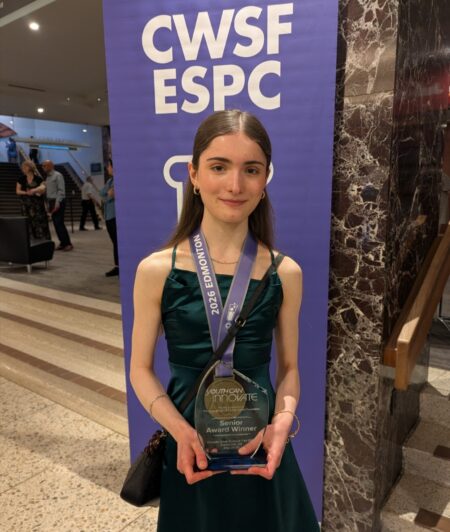


FALL RIVER: For Lockview High School student Avalon Lively, the more than $9,000 she won at the Canada-Wide Science Fair was exciting, but it wasn’t the highlight of the experience.
The Grade 12 student told The Laker News the moment that will stay with her long after the prize money is spent came when a fellow competitor living with anorexia nervosa approached her to talk about the project she had devoted months to researching.
“Knowing that it actually can change someone’s life meant a lot more to me,” said Lively during an interview Tuesday morning at Good Day Café in Fall River.
“There was only one person who had the courage to come up and talk to me, but there were probably others in the room who were struggling with the condition too.”
ADVERTISEMENT:


Lively, a Beaver Bank resident, earned the Challenge Award in the Disease and Illness category, recognizing the top senior project in that field at the prestigious science fair. She also received the You Can Innovate Award for originality and creativity, worth $1,000, before being selected as one of just four senior projects to receive an additional major award.
Altogether, her work brought home more than $9,000 in prize money.
Yet for the aspiring neuroscientist, the recognition was secondary to the impact her research could have on people living with anorexia nervosa.
Lively’s project examined the structural and functional brain abnormalities associated with anorexia nervosa, an eating disorder that affects both physical and mental health. Her goal was to better understand what is happening neurologically in patients, something she believes could eventually lead to improved diagnoses and treatments.
“With a lot of psychiatric conditions, we know what’s going on in the brain,” she explained.
“With anorexia, we don’t have that same level of understanding.
“If you understand the brain and the functions that are disrupted, then hopefully you can develop better treatments and maybe even targeted therapies.”
Check out Lively’s research at: https://partner.projectboard.world/ysc/project/anorexia-nervosa-in-the-eyes-of-neuroimaging-a-meta-analysis-of-fmri-and-mri-studies
ADVERTISEMENT:





What makes Lively’s achievement even more remarkable is that much of the work was completed independently.
While she reached out to university professors and researchers for guidance, many were unable to assist because of their own commitments.
That left the Lockview student to teach herself advanced research methods, including conducting a meta-analysis — a complex process that combines findings from numerous scientific studies to identify consistent patterns and conclusions.
“They don’t teach you that in high school,” she said with a laugh. “There were definitely a lot of learning curves.”
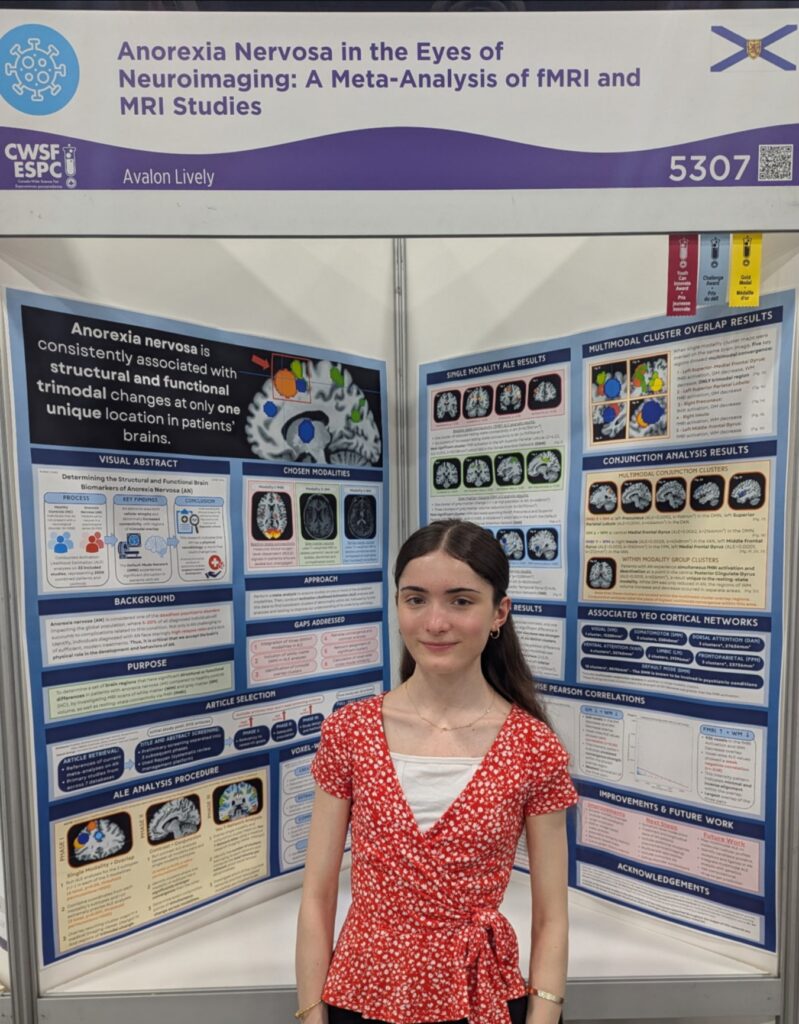
Balancing the project alongside a demanding Grade 12 course load required discipline and sacrifice.
“There were a lot of compromises this year,” she said.
“People ask me how I managed everything, and honestly, I don’t know. You just have to keep working at it.”
Her dedication paid off on the national stage, where she joined approximately 400 of Canada’s brightest young scientific minds.
“It was absolutely amazing,” said Lively. “Everyone there is so passionate about science. The ideas people were working on are the kinds of things that are going to change the world.”
ADVERTISEMENT:





The experience also reinforced her future.
This fall, Lively will attend McGill University, where she plans to study neuroscience. She hopes to continue developing her research and potentially work toward having her findings published.
For now, however, she remains focused on the message behind the project.
Anorexia nervosa is often misunderstood, she said, with many people believing it can be identified solely through physical appearance. Her research aimed to challenge those misconceptions and encourage a deeper understanding of the condition as a psychiatric disorder rooted in brain function.
“It meant a lot to know that my work was resonating with people,” she said.
“To know that someone felt seen and understood because of what I was studying — that’s worth more than any award.”
As she prepares to leave Lockview High for the next chapter of her academic journey, Lively hopes her success encourages other students to pursue their own research interests, no matter how intimidating the challenge may seem.
“You have to start somewhere,” she said. “If you’re passionate about something, people will recognize that and they’ll want to help.
“The important thing is to try.”