

ANTIGONISH: The Moose Conservation Association of Nova Scotia (MCANS) has written to the province’s Auditor General Kim Adair to urge her office to conduct their planned audit of environmental assessments of onshore wind energy projects as quickly as possible.
It has been our ongoing contention that the Eigg Mountain, Antigonish County, wind farm project is an obvious example of how badly that assessment process can go wrong.
For that reason we have asked the AG to extend particular attention to that development in the audit.
The public has a right to know that the safeguards supposed to be in place to protect the natural environment in the province are functioning properly.
The independent office of the AG is well placed to investigate the process free from political interference or bias.
ADVERTISEMENT:


The letter from MCANS reads as follows:
Dear Auditor General Adair,
I am writing to you on behalf of the Moose Conservation Association of Nova Scotia (MCANS) regarding your office’s plan to audit whether the Department of Environment and Climate Change is appropriately conducting environmental assessments (EA) for onshore wind energy projects and monitoring approved projects for compliance with terms and conditions.
We are deeply concerned that this process is seriously flawed. That concern began with Bear Head Energy’s plan to develop a hydrogen and ammonia production facility in Point Tupper, Nova Scotia. As first proposed, the plant would be powered utilizing hundreds of wind turbines, erected in a number of locations in Pictou and Guysborough counties.
Our initial interest was in the wind energy projects and their potential effects on the survival of endangered mainland moose in those counties. The towers are most commonly placed across the province at higher elevations where wind energy yields are higher but these are typically the areas where those moose are present in the highest numbers.
In our research we found on Bear Head Energy’s website that they had spent 130 million US dollars on their site development in Point Tupper. Reviewing the proposed wind farm sites to power the plant we determined that most of them had yet to enter into the EA stage. Despite already knowing the answer to the question we inquired three times on Bear Head Energy’s website public question portal as to if the EA’s of the wind projects that would power the plant had been approved. We received no response to any of those inquiries. It was then that we began to question why the company would risk 130 million dollars in investment if they could not have known if the energy to power it would be available. Our fear was that the EA’s for the wind farms would be little more than a formality, rather than a very serious reflection on the suitability of the areas they would be placed in.
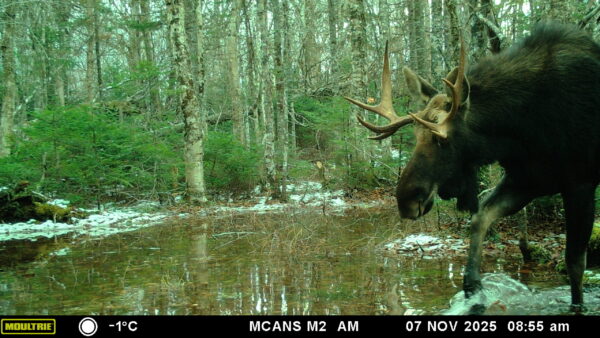
Despite that concern MCANS began a comprehensive investigation over a year ago of the proposed Eigg Mountain wind farm development in Antigonish County. That detailed examination included the placement of a single trail camera in a spot our expert in the area determined would be the best to reflect the frequency of use of the area by endangered moose. Over that year that single camera has consistently yielded significantly more moose observations than the EA’s conductors 13 cameras combined. Over the course of our observations it was determined that the project’s placement was in the worst possible location, interwoven with the Eigg Mountain James River Wilderness Area, in a particularly vital wetland portion of their habitat. MCANS ‘objection to the suitability of the site outlined in our public comments to the EA had no effect on the Minister of Environment and Climate Change decision to approve the projects EA. Similarly our recent comments to the council of the Municipality of the County of Antigonish regarding the rezoning required for the project to proceed fell on deaf ears.
Being a significant shareholder and on the board of directors of a wind turbine company for over a decade I am well aware of the importance the public places on these types of developments. They view them from a global perspective, in large part, as a necessity in a worldwide fight against climate change. In some cases the local environment becomes a secondary consideration or an acceptable tradeoff. Taxation and jobs are an added incentive to accept them without all due consideration. The result is if it is green in the climate sense it gets green lighted even if it makes no environmental sense.
When the Minister approved the Eigg Mountain EA he bragged that he had okayed 17 such projects. In fact no wind farm project has ever been rejected in the province regardless of its location or the environmental importance of that localized area. Given the current government’s stated goal of making the province a net energy exporter it is not an unreasonable question if in their eyes the climate agenda and the economic possibilities of it outweighs the environment agenda rather than the need of striking a balance between the two.
At MCANS we have never seen a location like that at the Eigg Mountain project area that screams out for that balance. Quite simply it should have been obvious that the project area is unsuitable for such a development but that decision has been outweighed by climate and economic concerns. MCANS welcomes your review and urges you to conduct it as soon as possible to inform future decisions and try to protect the environment from past ones. In that light we encourage you to take into careful consideration the Eigg Mountain wind project specifically as it is such a blatant case of the environment protection system not operating properly.
Respectfully,
Al Muir
President
Moose Conservation Association of Nova Scotia